
The Cognitive Revolution: Why Your Organisation's Brain Needs Coaching to Survive
Neuroscience proves that coaching isn't a nice-to-have: it is the infrastructure your leaders desperately need


📖 Edition 1 of The Coaching Culture Effect
Written by Paul Smith, MD, Author, Educator
How many times have you watched a perfectly capable leader fall apart under pressure? They are smart, talented, and experienced. However, when the heat turns up (a restructure, a missed target, a difficult client), they stop thinking clearly. They get reactive. Defensive. Short-sighted.
We tend to blame the individual. “They couldn’t handle the pressure,” but what if we rephrased our question and asked the following:
What if the problem is the environment they are operating in?
Here is what the neuroscience tells us:
“Under sustained threat, the human brain literally shuts down its strategic thinking centre and defaults to survival mode. Ironically, in modern corporate environments, most organisations are accidentally designed to keep their leaders in survival mode.”
The antidote? A Coaching Culture. Why? Because it protects the brain’s ability to think clearly when it matters most.
Explaining the Neuroscience
Let me introduce you to the part of our brain called the prefrontal cortex, or PFC for short. Think of it as your strategic brain. It handles:
Long-term thinking
Complex problem-solving
Impulse control
Emotional regulation
Seeing the big picture
When your PFC is working well, you are at your best as a leader.
Now, meet your amygdala. Think of this as your alarm system. It scans for threats (physical or psychological) and when it detects one, it takes over.
When your amygdala is in charge:
You get defensive
You make quick, reactive decisions
You lose perspective
You struggle to listen or collaborate
This is what psychologists call the “amygdala hijack,” (which happens to all of us).
The problem is that in most organisations, leaders are walking around in a state of chronic, low-grade amygdala activation. Unrealistic targets. Political manoeuvring. Fear of failure. Blame cultures. All of these keep the alarm system ringing (and we wonder why burnout figures are rising each year.)
When we explore research in this area, Carol Dweck’s famous work on Mindset (2006) showed that people who believe they can grow and learn are more resilient and successful.
But wait, neuroscience takes this further.
Research by Davidson and McEwen (2012) proved that our brains are plastic, “they physically change in response to our experiences.” When we engage in reflective, curious, non-judgemental thinking (the type of thinking coaching encourages), we actually thicken the prefrontal cortex. I.e. we build a stronger strategic brain.
At the same time, Amy Arnsten from Yale (2009) demonstrated that when stress hormones spike, the prefrontal cortex literally goes offline. The alarm system takes over. We literally cannot think strategically, no matter how smart we are.
A 1998 study by McCraty and colleagues found soemthing, I personally found fascinating:
“That just four weeks of emotional self-management training (techniques that share core principles with coaching) reduced cortisol levels by an average of 23% and significantly improved emotional well-being.”
We are not talking therapy here; we are talking about how coaching can be a cognitive performance enhancer.
However, (and this is the critical point for organisations) these benefits don’t last unless the environment reinforces them. A meta-analysis by Theeboom, Beersma, and van Vianen (2014) looked at 37 coaching studies. They found that coaching works brilliantly, but only when the surrounding culture supports it. Send a leader to a coaching programme, and they return to a threat-ridden, command-and-control culture, and their new behaviours fade within weeks (I’m sure many of us have experienced or witnessed this).
As Rock and Schwartz (2006) wrote in the Harvard Business Review:
“Our brains are deeply social. They are shaped by the quality of our interactions with others. One coached leader swimming against a toxic cultural tide will eventually drown.”
The conclusion is unavoidable: coaching must be embedded into the entire organisation, not just offered to a few individuals for a temporary period of time.
What This Means for Your Organisation
If your organisation is high-pressure, target-driven, and risk-averse, you are probably keeping your leaders’ strategic brains offline. They are making reactive decisions, avoiding innovation, and burning out. Although many of us believe so, that is not a leadership problem, it is a cultural design problem.
Organisations that embed coaching into their culture (not as a programme, but as the way things are done) create a completely different environment:
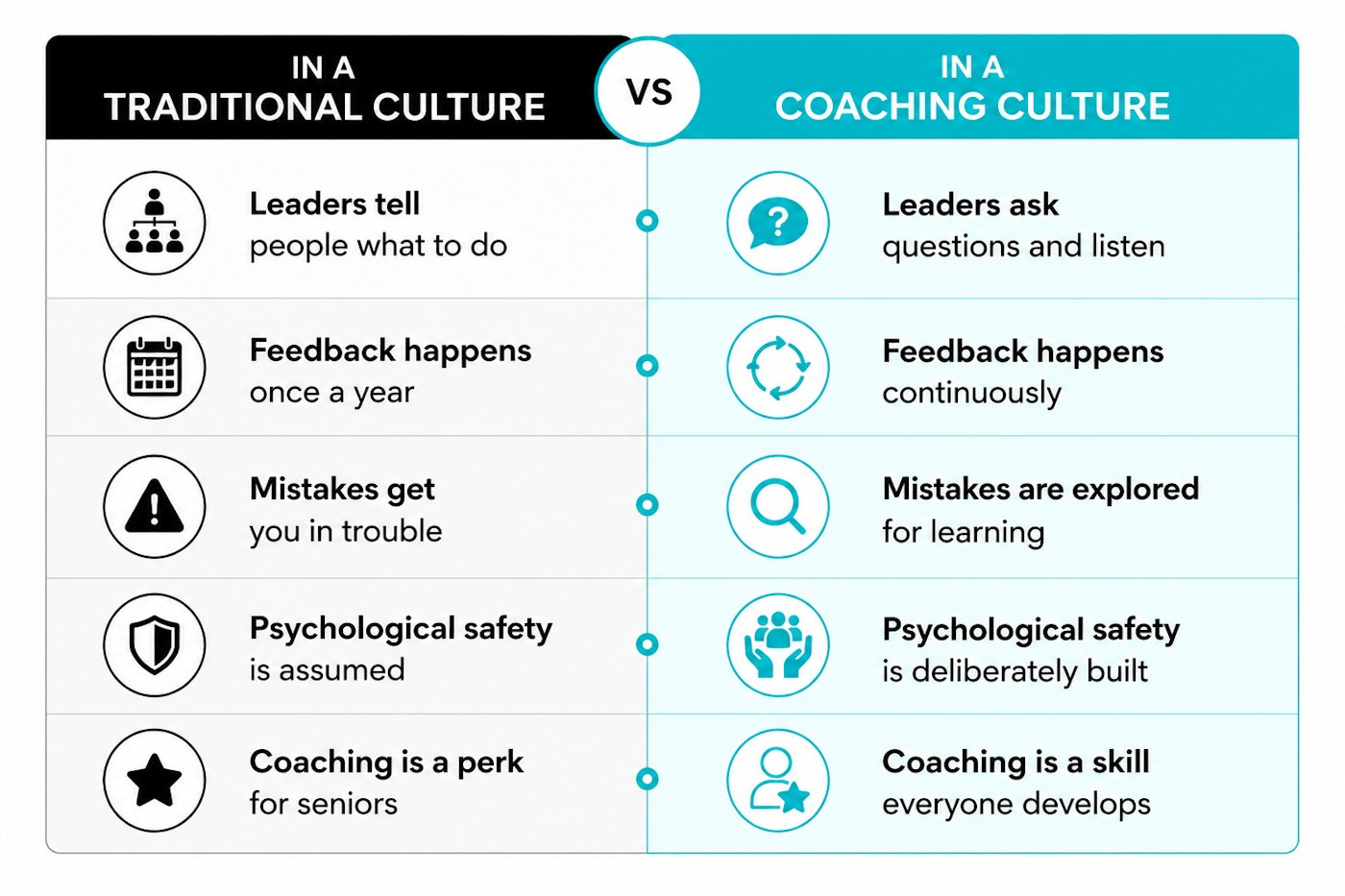
The results speak for themselves:
Faster decision-making because leaders retain their strategic brain under pressure.
Better retention because people feel safe, valued, and developed.
More innovation because curiosity replaces fear.
As Boyatzis and Jack (2018) argue in their neuroscience research, “lasting behavioural change requires both individual coaching and a supportive social environment.” The organisation itself must become the coach.
What Coaches and HR Leaders Can Do Right Now
If you are a coach, an HR leader, or an organisational development professional, your job is no longer just coaching individuals. Your job needs to become focused on coaching the system.
Here is a simple, four-step framework to start embedding coaching into your organisation’s DNA.
Step 1: Find the Threat Triggers
Before you can build a coaching culture, you need to know where the organisation is actively destroying it. In our Level 7 Organisational Coaching Programme we equip our coaches with several tools to map these out. Here,we have simplified this step into a few questions.
Ask yourself:
Performance reviews: Do they feel like a judgement or a conversation?
Meetings: Are they status updates or genuine discussions?
Failure: When someone makes a mistake, is it punished or investigated with curiosity?
Communication: Do leaders say “Do this” or “What do you think?”
The exercise: Rate each of these areas from 1 (high threat) to 10 (high safety). Anything below a 5 could be keeping your leaders’ strategic brains offline.
Step 2: Teach Leaders to Coach, Not Fix
Most leaders have been promoted because they are good at solving problems. Coaching requires a completely different skill set.
You need to teach your leaders:
Deep listening: Listening to understand, not just to reply.
Curious questioning: Replacing advice with inquiry. Instead of “Here is what I would do,” ask, “What have you tried, and what have you learned?”
Feedback as data: Shifting feedback from “You did this wrong” to “Here is what I observed, what do you make of it?”
A practical metric: In your next leadership team meeting, count how many questions are asked versus how many statements are made. A coaching culture starts with at least three questions for every statement.
Step 3: Weave Coaching into Everyday Processes
Coaching cannot be a standalone intervention. It must become part of how work gets done.
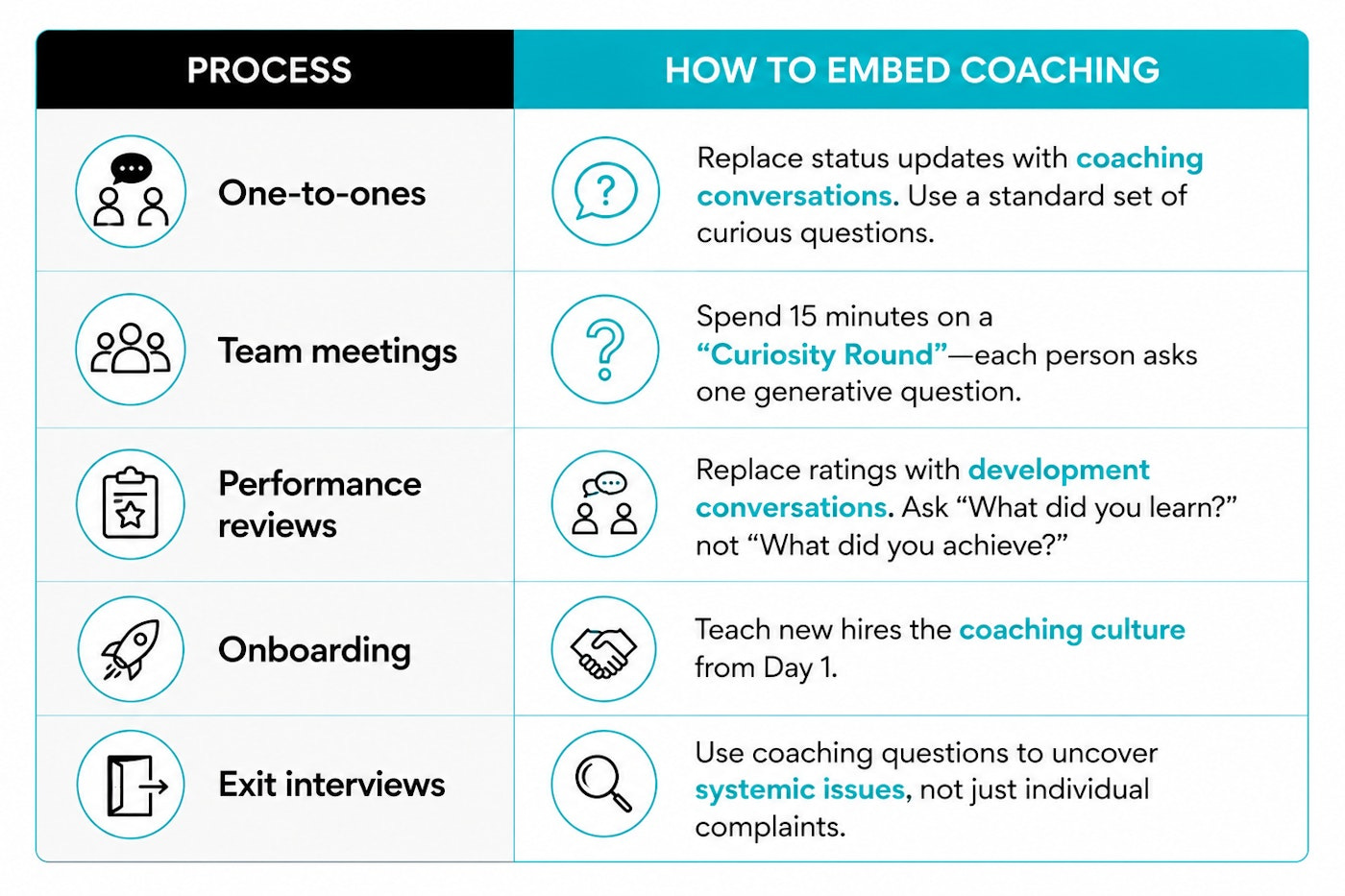
Step 4: Measure What Matters
If you want to prove the ROI of embedding coaching, track the right things:
Psychological safety scores: (there is a simple, validated 7-question survey by Amy Edmondson which can be found online).
Retention rates: particularly among your high-potential talent.
Internal promotion rates: coaching cultures develop people from within.
Innovation metrics: how many new ideas are generated and implemented?
The business case is simple: Organisations with high psychological safety and embedded coaching cultures outperform their peers. The neuroscience explains why. This data should help you prove it.
Your Challenge This Week
Here is your practical, no-nonsense challenge for the next two weeks (because I love a bit of action):
Do not coach an individual. Coach a process instead.
Pick one organisational process that feels broken (perhaps the annual performance review, or the weekly team meeting). Redesign that single process using coaching principles:
Replace judgement with curiosity.
Replace reporting with reflection.
Replace directives with questions.
Implement it with one team. Observe what happens to their energy, engagement, and quality of thinking. Document the before and after. Then evaluate this evidence to look at the scaling change.
The Bottom Line
Organisational coaching is not a luxury. It is not a soft skill. It is not just for senior leaders.
It is a scientifically-proven infrastructure that protects and enhances the very thing your organisation depends on: the collective brainpower of your people.
Organisations that get this will build leaders who think clearly under pressure, adapt quickly to complexity, and innovate fearlessly, not because they were sent to a coaching course, but because they operate inside a coaching ecosystem.
Those that don’t will keep wondering why their expensive leadership programmes fail to deliver lasting change. The question is not whether you can afford to embed coaching into your culture. The question is whether you can afford not to.
About This Series: The Coaching Culture Effect
This article is the first in a bi-weekly series called The Coaching Culture Effect.
Our Purpose:
To educate organisations and aspiring organisational coaches on what organisational coaching truly is, and, more importantly, how it can be embedded into the very fabric of how work gets done. We are moving coaching from the periphery to the core.
Who This Series Is For:
Organisations seeking to build resilient, agile, and high-performing cultures.
HR and L&D leaders tasked with developing talent and driving cultural change.
Coaches and aspiring coaches (particularly those considering our Level 7 Organisational Coaching Programme) who want to move beyond 1:1 interventions and learn how to coach at the systemic level.
What to Expect:
Every two weeks, we will publish a research-backed, practically-focused article exploring a different dimension of organisational coaching. Future articles will cover:
The art of listening at scale
The science of asking better questions
Coaching for psychological safety
Measuring the ROI of coaching culture
Coaching in hybrid and remote environments
And much more.
Our Invitation:
If you are an organisation ready to embed coaching into your culture (or a coach ready to step up to the systemic level) we would love to walk this journey with you.
We deliver a Level 7 Organisational Coaching Programme designed specifically for professionals who want to lead this transformation. Those interested can join one of our cohorts as an individual or we can discuss delivering tailored cohorts within an organisation. If that sounds like you or your organisation, let’s talk.
On a final note, I would genuinely love to hear your thoughts.
What processes in your organisation keep leaders in threat mode? Have you ever tried to embed coaching into a system? Drop your reflections in the comments and don’t forget to subscribe to theis newsletter and let’s learn from each other.
Footnotes & References
Dweck, C. S. (2006). Mindset: The New Psychology of Success. Random House. https://www.proemergency.com/assets/dokumen/ebook_platinum/20231124092918-Mindset_The_New_Psychology_of_Success.pdf
Davidson, R. J., & McEwen, B. S. (2012). Social influences on neuroplasticity: Stress and interventions to promote well-being. Nature Neuroscience, 15(5), 689–695. https://pmc.ncbi.nlm.nih.gov/articles/PMC3491815/pdf/nihms366958.pdf
Arnsten, A. F. T. (2009). Stress signalling pathways that impair prefrontal cortex structure and function. Nature Reviews Neuroscience, 10(6), 410–422. https://pmc.ncbi.nlm.nih.gov/articles/PMC2907136/pdf/nihms197465.pdf
McCraty, R., Barrios-Choplin, B., Rozman, D., Atkinson, M., & Watkins, A. D. (1998). The impact of a new emotional self-management program on stress, emotions, heart rate variability, DHEA and cortisol. Integrative Physiological and Behavioral Science, 33(2), 151–170. https://doi.org/10.1007/BF02688660
Theeboom, T., Beersma, B., & van Vianen, A. E. M. (2014). Does coaching work? A meta-analysis on the effects of coaching on individual level outcomes in an organizational context. The Journal of Positive Psychology, 9(1), 1–18. https://doi.org/10.1080/17439760.2013.837499
Rock, D., & Schwartz, J. (2006). The neuroscience of leadership. Harvard Business Review, 84(10), 62–70. https://newventureswest.com/the-neuroscience-of-leadership/
Boyatzis, R. E., & Jack, A. I. (2018). The neuroscience of coaching. Consulting Psychology Journal: Practice and Research, 70(1), 1–16. https://psycnet.apa.org/doiLanding?doi=10.1037%2Fcpb0000095
Edmondson, A. C. (1999). Psychological safety and learning behavior in work teams. Administrative Science Quarterly, 44(2), 350–383. https://eric.ed.gov/?id=EJ589456
