


“I can’t understand why people are frightened of new ideas. I’m frightened of the old ones.” – John Cage
💫 Edition 47 of Coachology in Practice
Written by Paul Smith, Managing Director
Few phrases have saved more relationships, careers, and family holidays than the following:
“I just need some space.”
The opportunity to step back and make sense of what is going on. If I’m honest, I think we’ve all had moments where we’ve felt exactly that. Perhaps after a difficult conversation, before a presentation or after finding ourselves lying awake at two o’clock in the morning replaying a conversation from three weeks ago that the other person has almost certainly forgotten.
Sometimes, we become so immersed in their thoughts, emotions, and assumptions that we struggle to see the situation clearly.
In many ways, we can resemble the unforgettable Mrs Richards from Fawlty Towers:
“I paid for a view, and all I can see is the sea!”
To which Basil Fawlty, with admirable restraint, replies:
“Well, may I ask what you expected to see from a Torquay hotel bedroom window? Sydney Opera House perhaps?”
The joke, of course, is that Mrs Richards is so consumed by her own expectations and frustrations that she cannot appreciate the reality sitting directly in front of her and if we’re honest, haven’t we all been Mrs Richards at some point?
As discussed in our last edition, we often assume our problem is the situation itself, but more often than not, what overwhelms us is everything happening around the situation.
The thoughts.
The emotions.
The physical sensations.
The behaviours.
The stories we tell ourselves.
Which actually forms a useful tool in Cognitive Coaching known as the SPACE model.
Unlike the STAR model, which is more action-orientated, the SPACE model is less concerned with immediately fixing the problem and more concerned with helping the client understand their experience.
What is the SPACE Model?
Although it sounds like a model for astronauts or part of Elon Musk’s dream to live on Mars, SPACE is an acronym for the following:
Situation
Physiology
Actions
Cognitions
Emotions
The aim is to help clients gain a bird’s-eye view of what is happening before, during, and after a situation. In many ways, it allows clients to become observers of their own experience rather than prisoners of it.
Let’s explore each of the dimensions.
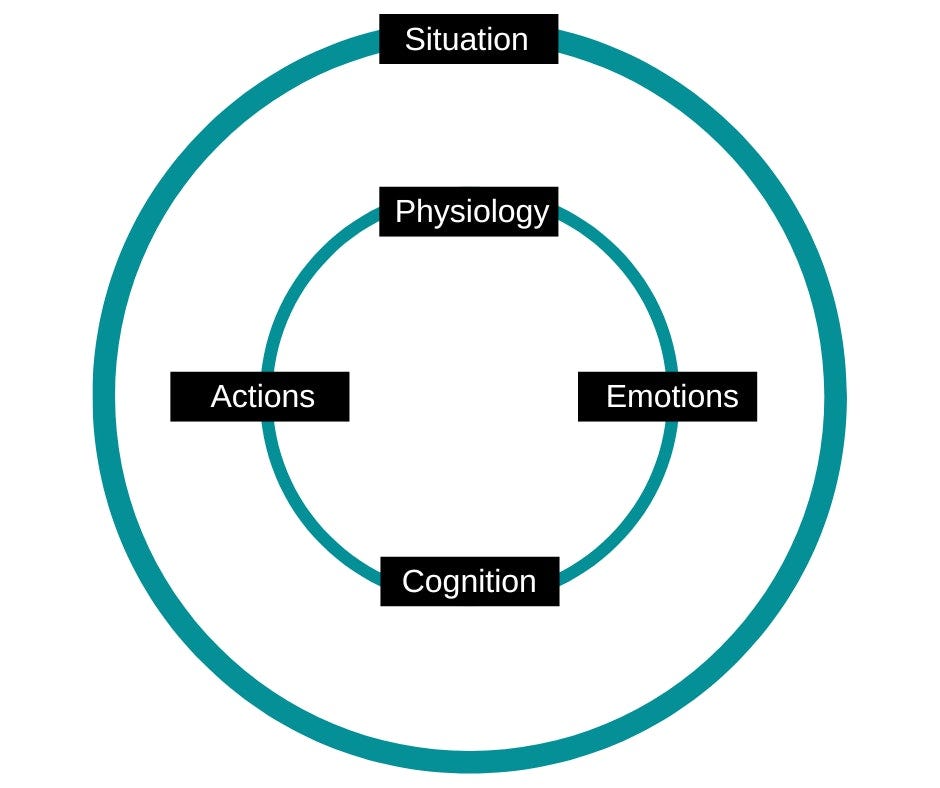
The SPACE Model
Situation
We begin with the situation itself. What is actually happening?
This might sound obvious, but clients often arrive with thoughts, emotions, and assumptions all mixed together. Our role is simply to help them untangle things and understand the situation from their perspective. We must be patient and not rush this stage, sometimes this takes longer than we expected. Remember, life stubbornly refuses to fit neatly into boxes.
The remaining stages can be worked through in any order, but I will work through them chronologically.
Physiology
Next in the model, we can explore what is happening physically when the situation occurs.
Does their heart race?
Do they experience tightness in their chest?
Does their breathing change?
Do their shoulders suddenly rise to somewhere around ear level?
Our bodies often know something is wrong before our minds catch up. Which perhaps explains why some emails can raise your blood pressure before you’ve even opened them.
Actions
Moving chronologically, we then explore their actions around the situation:
How are they behaving?
What are they doing before, during, and after the situation?
Do they avoid?
Do they withdraw?
Do they become defensive?
Do they say yes to things they secretly wish they had said no to?
Sometimes the behaviours that protect us are the very things keeping us stuck.
Cognitions
At this stage, we discuss and capture their thoughts before, during and after the situation.
What stories are they telling themselves?
What assumptions are they making?
What beliefs sit beneath the surface?
It is amazing how many clients carry around thoughts such as:
“I’m not good enough.”
“Everyone will judge me.”
“I always get this wrong.”
Yet rarely stopping to question whether these thoughts are facts or simply familiar opinions. Here, we could also introduce our ‘Thoughts are Opinions’ tool (see Edition 43 of Coachology in Practice).
Emotions
Finally, we explore and capture their emotions:
What are they feeling before the event?
What emotions arise during it?
And what emotions linger afterwards?
What emotions are arising as we discuss the event right now?
Keeping in mind that emotions are not problems to solve. They are information to understand.
Using the SPACE Model
What I particularly like about the SPACE model is that it isn’t rigid. Unlike many frameworks, there is no requirement to move from A to B in a perfectly straight line.
In fact, I often invite clients to choose where they want to begin. Some people want to talk about thoughts. Others want to talk about emotions. Some notice the physical sensations first.
There is no right answer. The goal is simply awareness.
A Practical Example
Take John, a senior software developer who dreads presenting to large audiences. The situation is straightforward. He has to speak in meetings. But around that situation exists a whole host of feelings and thoughts. His hands shake. His breathing becomes shallow. He avoids eye contact. He rushes through his slides, and running through his mind is one persistent thought:
“I look stupid when I make presentations.”
Unsurprisingly, anxiety follows, and because anxiety follows, he rushes. Because he rushes, he performs below his ability. Which then reinforces the thought that he isn’t a good presenter.
Round and round the cycle goes.
By mapping the experience through the SPACE model, John begins to notice something. He isn’t broken. He is simply experiencing a pattern, and patterns can change. Small changes to his preparation. Small changes to his thinking. Small changes to his behaviour. Over time, these changes begin to alter his experience, and confidence slowly follows.
Our Role as Coaches
As coaches, our role is not to diagnose, analyse, or rush clients towards solutions. Sometimes the greatest gift we can offer is exactly what the model promises. Space:
Space to reflect.
Space to explore.
Space to understand.
Clients are often trying to make sense of experiences they have never stopped to examine and once they can see the bigger picture, change often becomes much easier.
At times, I find it useful to begin with the SPACE model for deeper exploration before introducing the STAR model to focus on action and accountability. After all, it is difficult to decide where you are going if you haven’t first understood where you are.
As coaches, we must trust our intuition and know when each tool is most appropriate. Our role is not to fix; it is to provide a space.
If you’ve ever found yourself saying the words ‘I need some space’ after a stressful week, a difficult conversation, or Christmas dinner with the extended family, you’ll know exactly what I mean.
The space we provide produces the power of Coachology.
💫 Next Week: Edition 48, “Future Pacing: It Helps to Work Backwards“
Keywords: Coachology, Coaching, Coachologist, Coaching Psychology, Cognitive Behavioural Coaching, Reactive Language, Proactive Language, SPACE Model, Coaching tools

Great article and model! I like the flexibility that helps us to follow the client vice leading them through a structured model.